 11
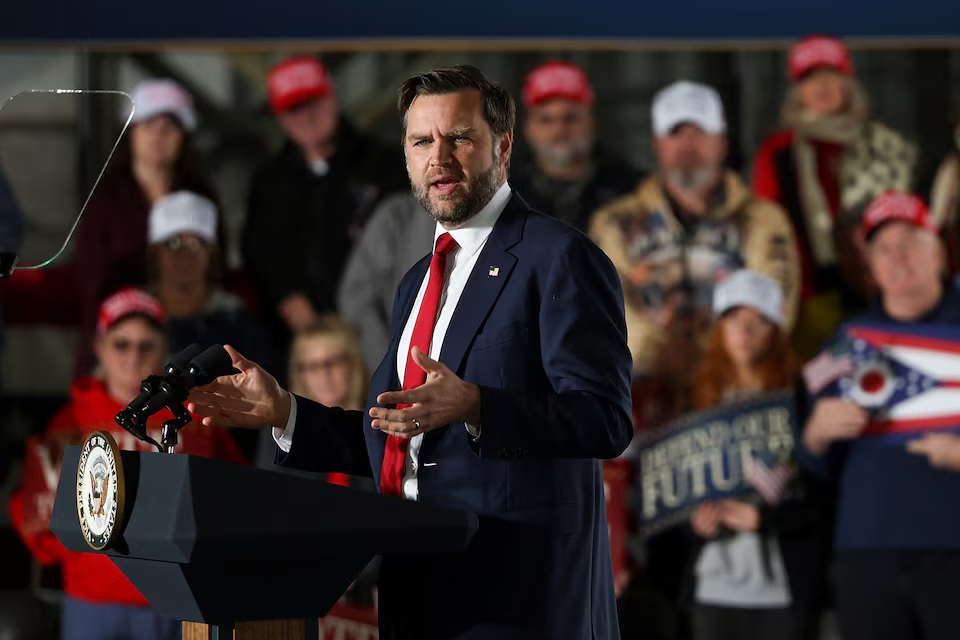
Washington: In the closing stretch of his campaign to rescue Republican fortunes in the midterm elections, Vice President JD Vance shifted strategy, speaking less about President Donald Trump and more about the issues that define his own political identity.
According to a Reuters review of half a dozen speeches delivered since the Republican convention in September, Vance made the case for Republicans, who lost control of Congress in Tuesday’s vote, almost entirely through the lens of his own policy portfolio. He largely avoided Trump’s signature policies, including the Iran war and deportations, as polls showed the president’s declining popularity weighing on Republican candidates.
Two people familiar with the strategy said the change was deliberate. Vance and his advisers viewed the issues he has championed, namely economic nationalism, foreign policy restraint and public safety, as politically powerful subjects on which he could speak with authority. While Trump embraced these themes as part of his MAGA movement, Vance had emerged as their leading advocate, the sources said.
The shift offers an early indication of how the 42-year-old vice president might carve out his own path as Republicans begin looking beyond the Trump era. Vance has not said whether he will seek the presidency in 2028, and Trump has not endorsed him or any other potential successor. Nevertheless, Vance is widely seen as a leading contender, and some Republican officials say he will need to inherit much of Trump’s coalition while distancing himself from the president’s political baggage.
Vance Makes His Unease Over the War Public
On Wednesday, Vance took a more visible step towards reinforcing his political brand with an unusually blunt post-election assessment. In a social media post, he blamed the Iran war for the Republican defeat and outlined a platform for the party’s recovery. He called for a swift end to the conflict and urged Republicans to focus on affordability, reassess the country’s foreign relationships and overhaul the United States’ relationship with Israel.
The post marked the first time Vance had openly sided with ending the war. Trump, by contrast, has dismissed Americans’ affordability concerns as a Democratic “hoax.” He launched the war against Iran following sustained lobbying from Israeli Prime Minister Benjamin Netanyahu and later endorsed Netanyahu in the Israeli election.
Three people familiar with the White House and Vance’s communications told Reuters that the vice president was not breaking with Trump, adding that White House Chief of Staff Susie Wiles had been informed of the post in advance. It could not be determined whether Trump himself knew beforehand.
On Friday, Trump reshuffled the senior White House leadership, replacing Wiles with Stephen Miller, a move suggesting the administration intends to double down on some of its more hardline policies.
Trump has acknowledged that the Iran war contributed to the Republican losses because of the resulting rise in fuel prices, but he has continued to defend the decision. “I would have done nothing different,” he told reporters on Wednesday. White House representatives pointed to those remarks, in which Trump said he understood Vance’s perspective on the election results. Representatives for Vance declined to comment.
Donald Trump Jr., the president’s eldest son, endorsed Vance’s remarks on social media, as did several conservative allies.
Using the Megaphone of the Vice Presidency
Michael Ricci, a Republican strategist and former adviser to House Speakers John Boehner and Paul Ryan, said the exchange further elevated Vance as a potential conservative standard-bearer after Trump. He said Vance’s message had compelled conservatives to debate the merits of the war and, more broadly, the core principles Republican presidential candidates should adopt in 2028.
“It’s simplistic to say this about him looking for ways to differentiate himself from Trump,” Ricci said. “This is about him using his megaphone of the vice presidency to set the terms of debate.”
Democrats, however, are preparing to link Vance, or any Republican nominee, to Trump in 2028, particularly if the president plays a significant role in vetting conservative hopefuls. Democratic strategist Igor Volsky said any Republican contender would face a real challenge in remaining viable for a general election while winning a primary that still requires deference to Trump.
Vance’s own standing did not emerge from the midterms untouched. Republicans lost in states where he campaigned, and some strategies he backed may have cost the party votes, including an advertisement by Ohio gubernatorial candidate Vivek Ramaswamy that cast doubt on the sexual abuse suffered by the winning Democratic candidate, Amy Acton.
Other potential 2028 contenders have offered their own explanations for the defeat. Texas Senator Ted Cruz said Republicans had not done enough on affordability, while Florida Governor Ron DeSantis argued that losing candidates had focused too heavily on transgender issues and overlooked voter concerns about data centres and artificial intelligence. Secretary of State Marco Rubio has remained silent.
Vance’s effort to shape the debate was evident in the final days of the campaign. In his stump speeches, he urged voters to support Republicans on the grounds that they would investigate fraud in federal healthcare and anti-poverty programmes, linking the issue to the administration’s immigration agenda and the cost of living. He almost entirely avoided discussing the Iran war and fuel prices, and rarely mentioned Trump by name.
“I want my kids to raise a family in a country that is vibrant and thriving and free and prosperous. I want the simple things,” Vance told one of his final rallies in North Carolina. “And because I want that for me, I want it for you too.”