 111
111 2
2 3
3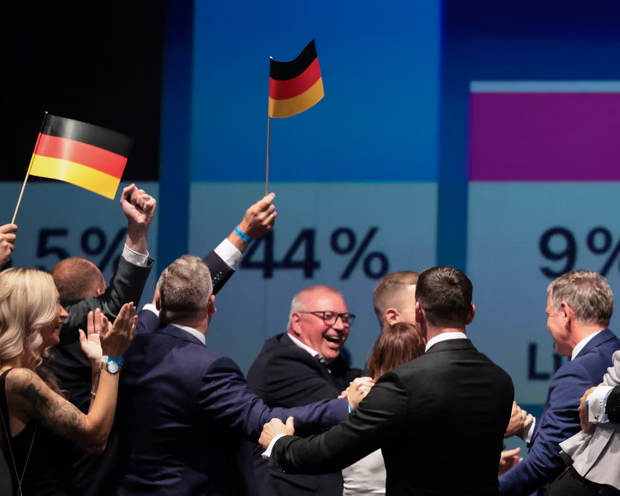
The sweeping electoral success of Germany’s far-right Alternative for Germany (AfD) in Saxony-Anhalt has emerged as a major warning sign for the country’s political establishment and for Europe’s broader democratic centre.
The AfD secured 43.8 percent of the vote in the eastern German state, more than doubling the performance of Chancellor Friedrich Merz’s Christian Democratic Union (CDU), which received 17.2 percent. The Social Democratic Party (SPD), the CDU’s coalition partner at the federal level, fell to just 9.3 percent.
Although the AfD won 39 of the 83 seats in the state parliament and therefore fell three seats short of an outright majority, the result represents its strongest performance in a German state election. It also brings the party closer than ever to potentially leading a German state government since the Second World War.
The significance of the result extends well beyond Saxony-Anhalt. The election has intensified concerns that the far right’s electoral expansion is becoming a broader European phenomenon rather than an isolated development.
Far-right parties have strengthened their position in several European countries, while upcoming elections in major states including France, Italy, Poland and Spain could further reshape the continent’s political landscape. Research cited in recent political analysis indicates that more than one in five European voters now support far-right parties, compared with substantially lower levels in previous decades.
However, the Saxony-Anhalt result should also be viewed in its regional context. The state has traditionally been one of the AfD’s strongest areas, and its electorate is relatively small compared with Germany as a whole. Consequently, the result alone cannot establish that the AfD is certain to achieve comparable levels of support nationally.
The more significant issue may be the collapse of support for Germany’s established parties.
The CDU’s sharp decline, combined with the SPD’s poor performance, reflects growing dissatisfaction with the political establishment. Economic stagnation, the cost of living, immigration, housing pressures and concerns about the direction of government policy have created fertile ground for anti-establishment parties.
The AfD has benefited from this frustration by presenting itself as an alternative to what it portrays as an ineffective political establishment.
This creates a difficult dilemma for mainstream parties. Maintaining a political firewall against the AfD prevents formal cooperation, but prolonged exclusion can also leave the party outside the responsibilities and compromises of government while allowing it to campaign as an uncompromised opposition force.
One of the most important developments is the gradual normalisation of far-right ideas within mainstream political debate.
Issues such as immigration, national identity and border control have increasingly moved toward the centre of European political discussion. When mainstream parties adopt elements of far-right rhetoric in an effort to recover voters, they can unintentionally strengthen the political relevance of the very ideas they are attempting to contain.
This means that the challenge facing European democracies is not simply whether far-right parties enter government. Their influence can grow even while they remain formally excluded from governing coalitions.
The rise of the AfD also exposes a deeper problem: declining confidence in democratic institutions.
Political exclusion alone cannot resolve the grievances driving voters toward populist and far-right movements. If mainstream parties fail to deliver improvements in economic security, housing, public services and social stability, frustration may continue to translate into support for political forces promising radical change.
At the same time, treating far-right parties as an ordinary political alternative without considering their more extreme positions carries its own risks. Germany’s historical experience makes the country particularly sensitive to the consequences of political movements that challenge liberal democratic norms.
The developments in Germany place European democracies before a difficult strategic choice. They must defend democratic institutions while also addressing the legitimate economic and social concerns that are contributing to political dissatisfaction.
Simply condemning far-right voters is unlikely to reverse the trend. Equally, attempting to compete with far-right parties solely by adopting their positions could further legitimise those ideas.
The more sustainable response is likely to involve restoring confidence in democratic politics through effective governance, economic opportunity, stronger public services and credible solutions to immigration and integration.
The AfD’s victory in Saxony-Anhalt should therefore be regarded neither as an isolated regional event nor as proof that the far right is destined to take power across Europe. It is, however, a powerful warning that the political centre is under sustained pressure.
With several important European elections approaching, the ability of mainstream democratic parties to regain public trust may determine whether the current far-right surge becomes a temporary electoral wave or a lasting transformation of Europe’s political order.