 11
11
The war in Ukraine is increasingly becoming a test not only of military endurance but also of the credibility of the international system. As Russia intensifies attacks on Ukrainian cities and critical infrastructure ahead of another difficult winter, the central question confronting Western governments is whether continued restraint can produce peace—or whether it risks allowing a prolonged conflict to become a permanent feature of European security.
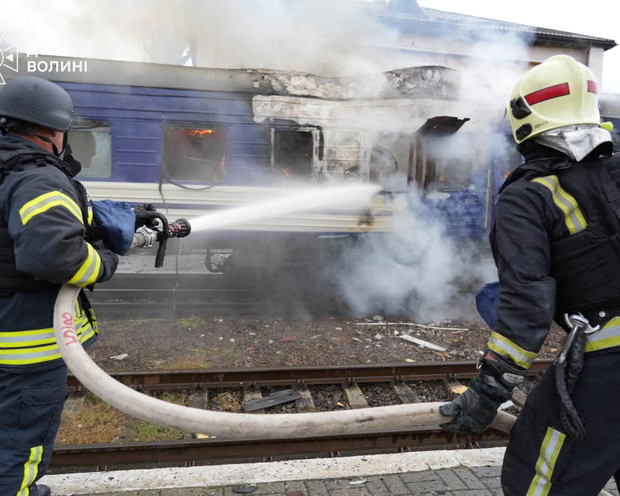
The latest phase of the war has been marked by a growing emphasis on attacks against infrastructure and economic targets. Russian missile and drone strikes have increasingly threatened electricity, water supplies, transport networks, medical facilities and other infrastructure essential to civilian life. With winter approaching, the consequences of such attacks could extend well beyond immediate casualties, potentially creating large-scale displacement and severe humanitarian pressures.
At the heart of the crisis is the question of Russia’s strategic calculations. Moscow continues to present the war as a campaign that can ultimately achieve its objectives, while Ukraine and its Western partners argue that Russia has failed to secure a decisive military victory despite enormous costs. The persistence of the conflict suggests that neither battlefield pressure nor economic consequences alone have yet persuaded the Kremlin to accept a political settlement.
This creates a dangerous dynamic. When neither side believes that it has exhausted its options, war can become self-perpetuating. Military setbacks lead to new offensives, which trigger further retaliation, while diplomatic initiatives repeatedly fail to produce a sustainable framework for negotiations.
One of the most consequential factors is the uncertainty surrounding Western strategy. European governments continue to support Ukraine, but the level and reliability of American involvement remain a critical variable. The resulting uncertainty complicates Kyiv’s military planning and may encourage Moscow to believe that time remains on its side.
Europe has attempted to compensate for shifts in US policy through financial assistance, military support and increased defence planning. Yet replacing American capabilities is neither immediate nor straightforward. The problem is therefore not simply how much assistance Ukraine receives, but whether Western policy presents Moscow with a sufficiently clear and unified strategic calculation.
Recent events have demonstrated the broader risks. A Russian drone strike near the Polish-Ukrainian border, following a major wave of attacks across Ukraine, prompted renewed concerns about the possibility of the conflict affecting NATO territory more directly. Polish authorities convened an emergency meeting, while Ukrainian officials described the incident as a threat to European security.
There is widespread international support for ending the war, but the meaning of “peace” remains deeply contested. For Ukraine, a settlement that merely freezes the conflict without credible security guarantees could leave the country vulnerable to renewed Russian aggression. For Russia, meanwhile, any agreement that fails to deliver meaningful strategic gains could be difficult for the Kremlin to present domestically as a success.
This is why diplomacy cannot simply be reduced to arranging another meeting between political leaders. A durable settlement would require security guarantees, mechanisms for accountability, arrangements concerning occupied territories and a credible framework capable of preventing another escalation.
The absence of such a framework has contributed to what can increasingly be described as a “forever war” dynamic: repeated diplomatic initiatives without sufficient leverage, temporary pauses followed by renewed fighting, and an international community gradually becoming accustomed to a conflict that once appeared exceptional.
Another central issue is accountability. Allegations of war crimes and attacks affecting civilians have generated international investigations and condemnation, but the continuing nature of the conflict demonstrates the limits of accountability when fighting remains active.
The broader danger is normalization. When attacks on civilian infrastructure become routine, the international community risks treating extraordinary violence as an ordinary feature of geopolitics. The humanitarian consequences then become statistics rather than a catalyst for political action.
Information warfare compounds the problem. Restricted access, state propaganda, censorship and selective disclosure can make it increasingly difficult for domestic populations to understand the true costs of war. Independent journalism and credible international investigations therefore remain essential not only for documenting violations but also for maintaining public pressure for a political solution.
The argument for stronger Western action faces an obvious counterargument: direct NATO military intervention against Russian forces could transform the Ukraine conflict into a much wider confrontation between nuclear-armed powers.
That risk cannot be dismissed. Calls for NATO to directly strike Russian missile or drone facilities therefore represent an extraordinary escalation and carry consequences that extend far beyond Ukraine.
Yet the opposite danger must also be considered. If Western governments repeatedly establish red lines but fail to enforce meaningful consequences when they are crossed, deterrence can weaken. The challenge is finding a strategy that increases the cost of continued aggression without triggering a direct NATO-Russia war.
That could involve strengthening Ukraine’s air and missile defence, accelerating European defence production, expanding intelligence and logistical support, tightening sanctions enforcement and providing Kyiv with the means to protect its population and infrastructure. Such measures would not guarantee peace, but they could alter the strategic balance on which future negotiations depend.
The Ukraine war is ultimately a test of political endurance. Democracies must sustain public support for a long-term strategy while dealing with economic pressures, electoral cycles and competing international crises.
The danger is that fatigue becomes policy.
A conflict that receives less attention does not necessarily become less dangerous. On the contrary, prolonged wars can become more destructive precisely because the world becomes accustomed to them.
Ukraine therefore needs more than expressions of solidarity. It needs a coherent Western strategy that combines military deterrence with credible diplomacy. Russia needs to understand that continued aggression will not improve its negotiating position indefinitely, while Ukraine needs confidence that any eventual peace will provide genuine security rather than merely postpone the next war.
The coming winter could become another test of that resolve. If Russia continues targeting the infrastructure on which millions of Ukrainians depend, Western governments will face a difficult choice between accepting an increasingly entrenched war and taking greater risks to change its trajectory.
The objective should not be endless confrontation. It should be a peace strong enough to endure.
And that requires Western democracies to demonstrate that supporting Ukraine is not simply a short-term political commitment, but part of a broader defence of sovereignty, international law and the principle that military force cannot permanently determine the future of a European nation.