11
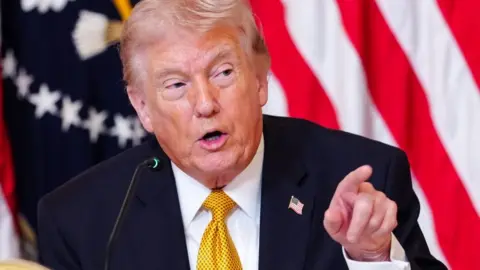
The scale of the Republican defeat in Tuesday’s US midterm elections has prompted celebrations among Donald Trump’s critics at home and abroad. Yet barring any unforeseen development, Trump will remain in the Oval Office for a further two years and ten weeks, a fact the White House itself underlined in a social media post declaring: “PSA [Public Service Announcement]: Trump is still your president.” That reality, analysts argue, should temper expectations that the era of Trumpism is over.
A Historic Repudiation
By any measure, the results were extraordinary. Democrats swept Republicans out of even their deepest heartlands, delivering a 16% swing in the popular vote for the House of Representatives. That surpassed the 11.2% swing recorded in the Watergate midterms of November 1974, which followed the resignation of Richard Nixon. Coming after the defeats of Trump allies in Serbia and Brazil, the outcome was widely interpreted not as a routine midterm setback, but as a broad rejection of the second Trump presidency.
Critics had accused Trump of seeking to shape the elections in his favour, through redistricting and by laying the groundwork for claims that the vote was rigged. The result, however, suggested that the American electoral system proved resilient and that voters were determined to make their voices heard.
Beyond the United States, many will be tempted to see the result as the moment the momentum of nationalist populism stalled. The fall of Hungary’s Viktor Orbán in April was significant, but a setback for Trump carries far greater weight. Given the power of the United States, Trump has for a decade been regarded as the driving force behind the global populist movement.
The Risk of Complacency
The danger, however, is that opponents of nationalist populism interpret the result as a permanent turning point. Critics argue that Trump made a similar error after his November 2024 victory over Kamala Harris, reading a vote driven largely by frustration over rising grocery and fuel prices as a lasting cultural shift and a broad mandate for sweeping change, from dismantling federal agencies to aggressive immigration enforcement and, ultimately, the war with Iran.
The equivalent mistake now would be to assume that the midterm results mark the end of Trumpism and a swift return to political normality. If Trump was possible once, the argument goes, a similar figure could emerge again.
That lesson carries particular weight for America’s traditional allies in Britain, the European Union and beyond. Even with Congress soon in Democratic hands, and even if Trump’s eventual successor embraces internationalism and a rules-based order, the reliability of the United States as an ally can no longer be taken for granted. Washington’s role as a guarantor of Western security now appears contingent on electoral outcomes, strengthening the case for Europe and other partners to invest more heavily in their own defence.
Has Populism Peaked?
Nationalist populism has undoubtedly been damaged, and Trump’s defeat may serve as a warning to voters in France and Germany considering support for Marine Le Pen or the AfD. Yet it remains unclear whether Trump’s setback reflects an inherent weakness in grievance-based politics or the consequences of specific, avoidable decisions. Chief among these was the decision to attack Iran, which contradicted his core pledge to MAGA supporters to end wars rather than start them and fuelled the very inflation he had been elected to tackle.
It is also difficult to speak of inevitable failure when describing a politician who, despite the turbulence of his first term and the events of 6 January 2021, returned to power less than four years later.
A Weakened, Not Tamed, President
Trump has lost the compliant Congress that allowed him to govern with limited restraint, but a weakened president is not necessarily a restrained one. One seasoned Washington observer has warned that Trump in defeat could behave like “a cornered animal.” Foreign policy remains largely the preserve of the president, and Trump has strong incentives to act on the world stage: to secure a legacy that offsets this week’s defeat, and to remain at the centre of attention.
He may heed the call of Vice President JD Vance, who in a statement on X all but broke with his boss in urging an end to the Iran war, even if that means a significant climbdown. Alternatively, he could escalate and push for regime change in Tehran, which he may see as the historic achievement he seeks. Until 20 January 2029, those decisions remain his.
The Israel Factor
The relationship with Israel illustrates how much influence Trump still wields. Israel’s own elections last week did not deliver the decisive rejection of Benjamin Netanyahu that many of his opponents sought, but they did erase his parliamentary majority. As coalition negotiations continue, the US midterms are already shaping the debate. Israeli opposition leaders argue that Netanyahu’s closeness to Trump, long presented as a strategic asset, has become a liability, leaving him “toxic” among the Democrats who will soon hold power in Congress.
On the morning of election day, Trump announced the termination of military aid to Israel, a move widely seen as an attempt to appeal to Republicans sceptical of US support for the country, including those aligned with commentator Tucker Carlson. He could pursue that path further, particularly if he holds Netanyahu responsible for the joint US-Israeli war on Iran that damaged his presidency, or he could defy Vance and draw closer to the Israeli leader.
The Other Side of the Argument
Trump’s supporters reject the notion that the midterms represent a verdict on his broader agenda. They point out that the party holding the White House has historically struggled in midterm elections, and argue that the results reflect economic pressures and the cost of the Iran conflict rather than a rejection of his positions on immigration, trade and national sovereignty. Some Republicans also contend that a Democratic Congress will give Trump a clear foil heading into 2028, and that the coalition he built remains a powerful force within the party.
Conclusion
What is beyond dispute is that the balance of power in Washington is shifting. Democrats will soon be able to investigate allegations of misconduct and exercise oversight of the administration, while America’s allies may once again find counterparts in Washington who speak the language of partnership. Yet two facts remain unchanged: Trump’s presidency reshaped American and global politics, and for the next two years, he is still in charge.