11
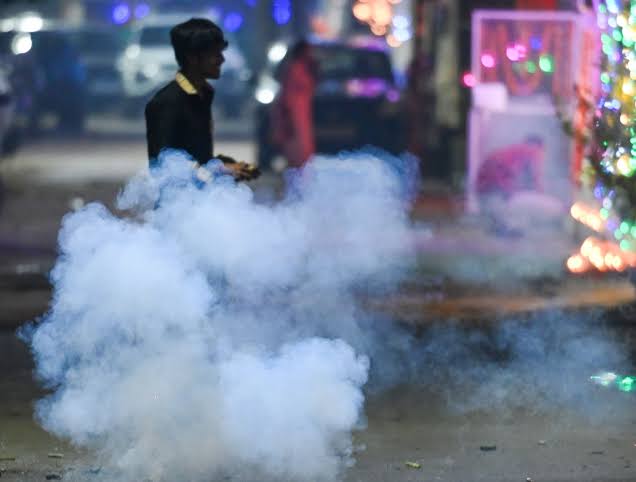
As India prepares to celebrate Diwali, the festival of lights, its capital is shrouded in some of the most toxic air in the world. Authorities have ordered schools in and around Delhi to offer online classes and urged residents to work from home and postpone private gatherings, as air quality deteriorated sharply ahead of a festival traditionally marked by the widespread bursting of firecrackers.
The emergency measures underline a grim annual pattern. Each winter, Delhi’s air turns hazardous, governments respond with temporary restrictions, and the underlying causes remain largely unresolved until the next season.
The World’s Most Polluted Major City
On Saturday morning, Delhi topped Swiss air quality monitor IQAir’s live ranking of the world’s most polluted major cities, recording a US air quality index reading of 581, roughly double that of Lahore in neighbouring Pakistan, at 285. IQAir’s figures are not directly comparable to India’s official index, which uses a different scale and methodology. Even so, India’s Central Pollution Control Board placed Delhi’s air quality at 363 on Saturday morning, firmly in the “very poor” category.
Friday’s readings were the worst recorded in the days before Diwali in eight years, according to local media citing official data. Several monitoring stations crossed into the “severe” range, with Jahangirpuri registering 449, Delhi Technological University 445 and Bawana 428. Forecasts from the Indian Institute of Tropical Meteorology warned that pollution could remain in the severe category from 7 to 9 November, precisely as Diwali celebrations peak on Sunday.
Emergency Curbs Under GRAP III
In response, the Commission for Air Quality Management invoked Stage III of the Graded Response Action Plan (GRAP) across Delhi and the National Capital Region on Friday as a precautionary measure. The restrictions halt non-essential construction and demolition work, shut stone crushers and mining operations, restrict older BS-III petrol and BS-IV diesel cars, limit the use of diesel generators and curb certain inter-state diesel buses. Authorities may also require offices to operate with half their staff working from home.
Delhi’s education department has directed schools to run hybrid classes for pupils up to Class 5 wherever online teaching is feasible, allowing families to keep the youngest children away from the outdoor air.
Why Diwali Matters, and Why It Is Not the Whole Story
Diwali firecrackers add a sharp, concentrated spike to pollution levels, and forecasters expect weaker wind dispersal on the festival night itself, allowing emissions to build up close to the ground. Yet the festival is only the most visible trigger in a much larger problem.
Every winter, cold and heavy air settles over northern India, trapping vehicle exhaust, construction dust and smoke from the burning of crop residue in surrounding agricultural states. Firecrackers worsen an atmosphere that is already saturated. This is why, year after year, restrictions on firecrackers alone have failed to deliver clean air, and why emergency measures tend to ease conditions only temporarily.
A Cycle of Reactive Policy
The recurring pattern of school closures, construction bans and work-from-home advisories has become a familiar feature of Delhi’s winters. Critics argue that such steps, while necessary in an emergency, treat the symptoms rather than the causes. Lasting improvement, they contend, requires sustained action on vehicular emissions, cleaner public transport, industrial compliance, dust control and viable alternatives for farmers who burn stubble to clear their fields quickly between harvests.
The human cost is considerable. Children, the elderly and people with respiratory and heart conditions are most vulnerable to prolonged exposure, and repeated disruption to schooling carries its own long-term toll on learning.
Officials and supporters of the current approach counter that the graded response system allows authorities to act early and proportionately, and that measures such as the shift to cleaner vehicle standards and stricter construction rules have begun to make a difference over time. They also point out that meteorological conditions, which no government can control, play a decisive role in how severe each winter becomes.
A Shared Regional Challenge
The crisis does not stop at Delhi’s boundaries. The same seasonal conditions grip much of the Indo-Gangetic plain, and Lahore, though recording markedly lower readings than Delhi on Saturday, faces its own recurring winter smog. Air pollution across the region is shaped by shared weather systems and agricultural practices that cross borders, suggesting that long-term solutions may ultimately require cooperation as much as national action.
Conclusion
As families in Delhi light lamps to celebrate the triumph of light over darkness, the city’s skies tell a different story. The emergency measures may soften the worst of this week’s smog, but unless the structural drivers of pollution are addressed, Delhi is likely to find itself in the same position next winter, and the one after that.