 11
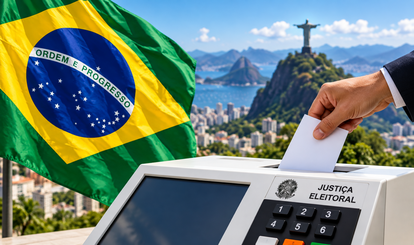
On Sunday, October 25, more than 150 million Brazilian voters will decide a presidential runoff that matters far beyond their borders. The contest pits President Luiz Inácio Lula da Silva, a veteran of the left seeking a fourth term, against Senator Flávio Bolsonaro, the 42-year-old son of former president Jair Bolsonaro and a close ally of US President Donald Trump. The polls show a race too close to call. The stakes, for Brazil’s democracy and for the world’s largest tropical rainforest, could hardly be higher.
The election has become a test of a broader global question: whether the rising tide of nationalist, populist leadership, with Washington at its centre, will extend to the country that holds the key to one of the planet’s most important climate defences.
A race that tightened dramatically
A month ago, many observers expected Lula to win comfortably. That changed on October 4, when Flávio Bolsonaro finished first in the opening round with around 47 percent of the vote against Lula’s 45 percent, leaving the president trailing by roughly two million votes. Since then, survey after survey has shown a technical tie, with the challenger often marginally ahead. Around one in ten voters reportedly remain open to changing their minds, leaving room for a late surprise.
The rise of Flávio Bolsonaro is all the more striking given his family’s recent history. His father is barred from running and is under house arrest, serving a 27-year sentence for his role in efforts to overturn the 2022 election he lost to Lula. Rather than sinking the movement, that conviction appears to have energised much of its base, which views the prosecution as political persecution. Flávio has pledged to carry his father’s legacy forward.
What each candidate offers
Flávio Bolsonaro’s campaign rests on themes that resonate strongly with large parts of the Brazilian electorate: a tough crackdown on crime and drug trafficking, lower taxes, a smaller state, and strong support for agribusiness, the backbone of Brazil’s export economy. His supporters argue that Lula’s governments have been too tolerant of crime, too fond of public spending and too willing to let environmental rules hold back farmers, miners and rural communities that feel ignored by elites in Brasília.
Lula, for his part, points to a social record built on poverty reduction and to a dramatic turnaround on deforestation. Since he returned to office in 2023, the rate of forest loss in the Brazilian Amazon has fallen by roughly half. Yet his own climate credentials are not spotless. His government has backed expanded oil exploration, including in sensitive offshore areas near the mouth of the Amazon, a policy that environmental groups have criticised as inconsistent with his green rhetoric.
Why the Amazon is on the ballot
Nearly 60 percent of the Amazon rainforest lies within Brazil. The forest stores vast quantities of carbon, regulates rainfall across South America and helps stabilise the global climate. Scientists have warned for years that parts of it are approaching a tipping point, beyond which large areas could degrade into drier savannah, releasing enormous amounts of carbon and accelerating global warming.
That is why environmental scientists have framed the runoff as a referendum on the forest’s future. Flávio Bolsonaro said in August that he does not believe climate change is real, and he has backed loosening environmental regulations. Climate researchers warn that a return to the enforcement practices of his father’s presidency, when deforestation reached its highest levels in over a decade, would almost certainly see forest loss rise again. One recent scientific estimate suggested such a reversal could clear around 1 percent of the entire Amazon basin’s rainforest within a single four-year term.
The implications extend into trade and finance. International support such as the Amazon Fund, financed largely by Norway and Germany, has historically been tied to verified enforcement results. European anti-deforestation rules on imports also mean that the policies of Brazil’s next government will shape access to one of its key markets.
The strongman connection
The Brazilian election cannot be separated from the international political climate. Flávio Bolsonaro is closely aligned with Trump, whose administration has withdrawn the United States from global climate commitments, championed fossil fuel expansion and expressed open scepticism of climate science. A Bolsonaro victory would reinforce a rightward shift across much of Latin America, where conservative candidates have made significant gains in recent elections.
Critics of this trend argue that a loose alliance of nationalist leaders is increasingly treating climate action as an ideological enemy rather than a shared challenge, at precisely the moment when scientists say the window for avoiding the worst impacts is narrowing. In that view, the combination of a climate-sceptic White House and a climate-sceptic government in Brasília would weaken two of the most consequential levers in global climate policy: the world’s largest economy and the custodian of its largest rainforest.
Supporters of these leaders reject that framing. They argue that voters are rebelling against climate and environmental policies imposed from above that raise living costs, restrict economic opportunity and are often designed by wealthy nations that grew rich by exploiting their own natural resources. For many rural Brazilians, the Amazon is not an abstraction but a place where they live and work, and where they want roads, jobs and development. Any honest analysis must recognise that these grievances are real, even if the environmental risks of acting on them are severe.
Democracy as a second fault line
Beyond climate, the runoff carries a democratic dimension. The 2022 election ended with Jair Bolsonaro’s supporters storming government buildings in Brasília in January 2023, and with a criminal conviction that has deeply polarised the country. Whoever wins on Sunday will inherit a nation split almost evenly down the middle, with each side deeply suspicious of the other. A narrow result, in either direction, will test the resilience of Brazil’s institutions and the willingness of the losing side to accept the outcome.
What happens next
If Lula wins, he will face pressure to reconcile his promises on the Amazon with his support for oil expansion, and to govern a country in which nearly half of voters rejected him. If Flávio Bolsonaro wins, the world will watch closely to see whether campaign rhetoric becomes policy, whether environmental enforcement is dismantled, and how far Brazil aligns itself with Washington on climate and foreign policy.
Either way, Sunday’s vote will be read far beyond Latin America. It will show whether the nationalist wave that has reshaped politics from the United States to Europe will now extend to the heart of the Amazon, and what that means for a planet whose climate future depends, in no small part, on what happens to the trees.