 11
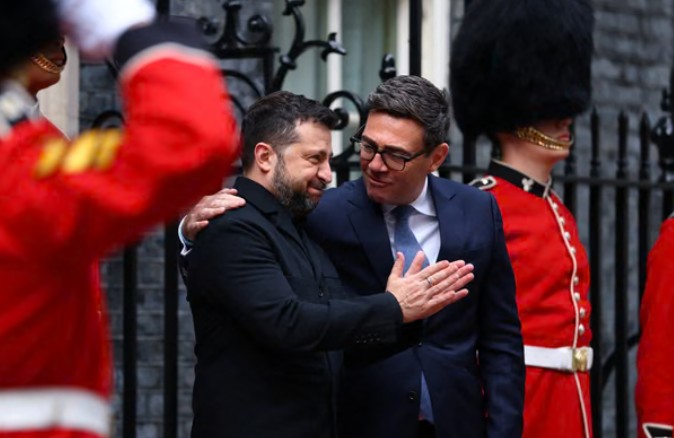
As Zelenskyy arrived in Downing Street, the Prime Minister chose caution over confrontation with Washington, while Badenoch pressed hard on Brexit, energy and the budget
London’s Prime Minister’s Questions on 14 October 2026 offered a clear picture of the balancing act facing Andy Burnham less than three months into his premiership. On one side stood an opposition eager to exploit his missteps at home. On the other stood a diplomatic crisis abroad, as Ukraine faces renewed pressure from the Trump administration and President Volodymyr Zelenskyy waited to be received in Downing Street that same afternoon. How Burnham handled both says a great deal about the kind of prime minister he intends to be.
The Ukraine Question: Restraint as Strategy
The most consequential moment came not from the Conservative benches but from Liberal Democrat leader Sir Ed Davey. He pressed Burnham to describe the Trump administration’s reported deal to buy Russian diesel as a betrayal of European security. Burnham refused to take the bait. He explained that he was choosing his words carefully because he was trying to lay the groundwork for reconciliation with Washington, and that his task was to rebuild bridges so that American support for Ukraine could return.
This was a deliberate choice. Only days earlier, Trump had suggested Ukrainians should choose a different leader, and he has argued that Moscow wants a settlement more than Kyiv does. A British prime minister denouncing Trump from the despatch box might win applause at home, but it would do little for Ukraine. Burnham’s calculation is that Britain is more useful to Kyiv as a bridge to Washington than as another European voice criticising the White House.
The test of this approach came hours later. Zelenskyy was met at Number 10 by an honour guard of the Irish Guards, an unusual gesture of respect, and Burnham told him that British support would not change. The two leaders agreed that Russia has shown no interest in peace. Burnham also said ministers were examining every possible avenue of further support and that Zelenskyy would not leave Britain empty-handed. He added that Kyiv was willing to discuss Trump’s proposed energy ceasefire, while noting that Russia had instead kept striking Ukraine’s critical infrastructure.
Burnham’s restraint carries a risk. If Washington does not respond, his carefulness may begin to look like timidity, and critics will ask what quiet diplomacy actually delivered. For now, his approach follows the line Keir Starmer took: stay close to Kyiv personally while keeping the transatlantic relationship intact.
Badenoch’s Attack: The Brexit Interference Row
Kemi Badenoch chose domestic ground. Her main line of attack was Burnham’s recent podcast remarks suggesting Russia had interfered in the 2016 EU referendum. Downing Street later clarified that the Prime Minister believed Moscow had very likely tried to influence the vote but did not believe it had changed the result. Badenoch mocked him for repeatedly putting his foot in his mouth and accused him of doing Russia’s work for it.
The row sharpened after the MI5 Director General, Ken McCallum, separated attempted interference from evidence that such attempts had succeeded. That distinction gave Badenoch her opening. Burnham replied that governments must call out hostile states that try to interfere in democratic processes.
The exchange matters beyond the Commons chamber. Burnham wants closer ties with the European Union while keeping Labour’s pledge not to rejoin the single market or customs union, or restore free movement, before the next election. Any suggestion that he questions the legitimacy of the Brexit vote gives his opponents an easy way to portray his EU ambitions as something larger than he admits.
Energy, Welfare and the Coming Budget
Badenoch also pressed the government over its delayed decisions on the Rosebank oil field and the Jackdaw gas field, accusing Burnham of stalling to manage divisions inside his own party. He said only that a decision would follow shortly. This is one of the hardest choices facing the government: approving the projects would anger Labour’s climate wing, while rejecting them would invite the charge of weakening Britain’s energy security.
On welfare, with the Budget about two weeks away, Burnham pointed to the Milburn report on young people and work and said the government intends to reduce the welfare bill. He also mentioned plans to adjust the pensions triple lock to help fund a new national care service. Both moves are politically sensitive and will face close scrutiny in the weeks ahead.
Farage, the Greens and Political Boundaries
Reform UK leader Nigel Farage called for a national security emergency over Channel crossings and made claims about security risks from Iranian arrivals. Before answering, Burnham noted the threats Farage has faced to his personal safety and said he would defend his right to speak despite their disagreements. He then argued that small boat crossings were falling and removals rising, while accepting that more needed to be done.
Burnham was also asked whether he would rule out cooperation with the Green Party after it passed a motion describing Zionism as racism. He condemned the motion as wrong and antisemitic and said his party could not partner with a party holding that view.
The Verdict
This PMQs showed two sides of Burnham. At home, he remains vulnerable to loose remarks, and Badenoch was effective in exposing that weakness. Abroad, he showed more discipline, putting Ukraine’s long-term interests ahead of an easy rhetorical win against Trump. The coming weeks will test both: the Budget and the North Sea decisions will decide his domestic standing, while his whole Ukraine strategy now rests on whether Washington can be persuaded to return. For Kyiv, Britain’s message on 14 October was steady. Whether it is enough will depend largely on decisions made outside London.