 11
11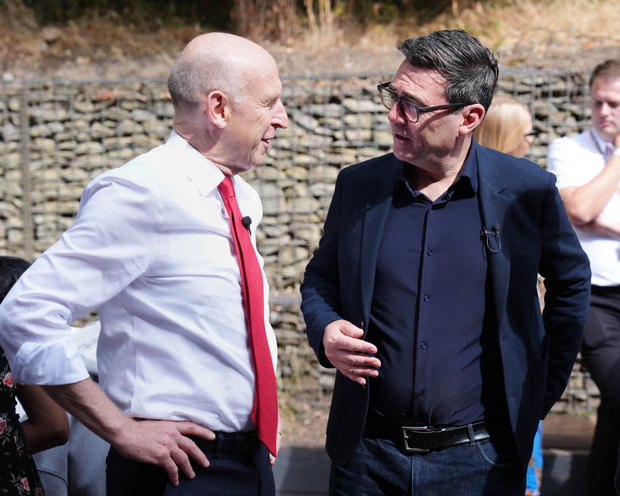
Prime Minister Andy Burnham and Chancellor John Healey are approaching the UK’s autumn budget under exceptionally tight fiscal and political constraints. The central challenge is how to reconcile Labour’s spending ambitions and election commitments with weak fiscal headroom, persistent inflation, high public debt and growing defence requirements.
One of Burnham’s most immediate difficulties is the government’s commitment not to raise income tax, national insurance or VAT. While politically significant, these commitments restrict the Treasury’s ability to respond to rising expenditure pressures.
At the same time, the UK’s national debt is approaching £3 trillion, leaving relatively little room for substantial additional borrowing. Maintaining the fiscal rules therefore becomes crucial to preserving market confidence, but doing so could force the government into difficult choices over public services and investment.
The international situation is complicating the budget further. The war involving Iran has contributed to higher energy prices and inflationary pressures, potentially weakening household purchasing power while increasing the government’s costs.
This creates a difficult policy dilemma: additional support for households could ease the cost-of-living burden, but broad measures would place further pressure on already constrained public finances. The Guardian reports that targeted assistance for vulnerable households could itself cost around £2 billion.
Defence is another major pressure point. Burnham’s government faces demands to increase military spending while simultaneously seeking to protect health, housing, transport and other public services.
The government has delayed achieving its planned 3% of GDP defence-spending target until a future spending review, illustrating the scale of the competing demands. Earlier plans to finance increased defence spending already involved reductions in capital allocations for other departments, while a further funding gap of almost £5 billion was identified for the wider defence investment programme.
Burnham’s support for greater public control of essential utilities, including Thames Water, also presents a financial and legal challenge. Although public ownership may fit Labour’s broader political agenda, taking control of a heavily indebted utility could expose the government to significant financial liabilities.
This highlights a wider tension in Burnham’s approach: the political desire to expand the state’s role in essential services must be matched by a credible assessment of what taxpayers can afford.
Welfare spending is another area where the government is likely to face difficult decisions. A comprehensive review of welfare expenditure, combined with concerns over youth unemployment, could push ministers toward reforms designed to reduce long-term spending while increasing participation in the labour market.
However, aggressive welfare reductions could create political resistance within Labour and among trade unions, particularly if they are perceived as conflicting with the party’s traditional commitment to social protection.
The October budget is therefore likely to be an important test of Burnham’s credibility as prime minister. His government has inherited a combination of high debt, constrained taxation options, inflationary risks, defence pressures and demands for improved public services.
The key challenge will not simply be finding additional money, but deciding which political promises can realistically be delivered first. Burnham and Healey will need to demonstrate that Labour can maintain fiscal discipline while still offering tangible improvements in living standards and public services.
Ultimately, the budget could establish the economic character of the Burnham government. If ministers succeed in protecting vulnerable households while maintaining fiscal credibility, they could strengthen confidence in their economic programme. If the competing demands prove impossible to reconcile, however, the budget could expose the limits of Labour’s policy ambitions.