 11
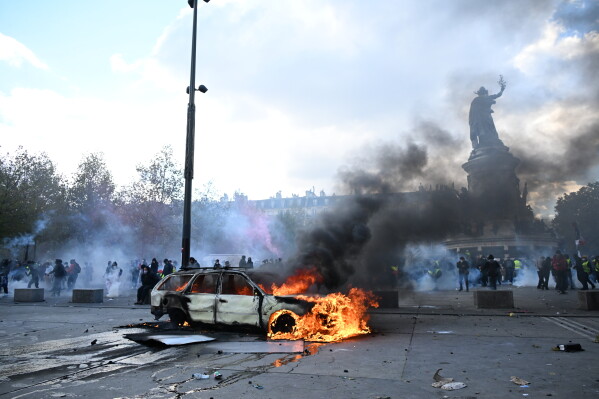
The nationwide protests of 17 October 2026 brought between 550,000 and 800,000 people onto the streets of France and ended with more than 1,800 arrests. What began in Paris as a largely festive gathering at Place de la République turned, by late afternoon, into running battles of stun grenades, burning cars and looted shopfronts.
The images will dominate the news cycle, but they obscure the more consequential story. France is facing a cost-of-living revolt with deep roots, a policing strategy that appears to inflame rather than calm, and a political class already competing to own the anger. Teargas can clear a square for an afternoon; it cannot resolve the grievances that filled it.
Fuel is once again the spark. Petrol prices reached a record of around €2.4 per litre at the end of September, reviving the same pressure point that launched the gilets jaunes (yellow vest) movement in 2018. Prominent figures from that movement, including Jerome Rodrigues, Priscillia Ludosky and Maxime Nicolle, publicly urged people to join the 17 October mobilisation.
The demands, however, have widened well beyond the petrol pump. Protesters are pushing for lower fuel costs and opposing the freeze on social benefits and public-sector salaries contained in the government’s draft budget. The CGT trade union, France Unbowed (La France Insoumise) and the French Communist Party all joined the call, giving the day a breadth that the original yellow vest protests lacked.
Education is a third front. In the weeks before the national day of action, student protests and school blockades disrupted more than 700 secondary schools and led to roughly 5,000 arrests. University students marched on 17 October explicitly in support of these lycée pupils, demanding more public investment from primary schools through to universities.
The Interior Ministry had warned of clashes and placed restrictions on demonstration routes in Paris. On the day, that caution translated into an aggressive posture early on. Police fired teargas into Place de la République shortly after 1pm, with no clear triggering incident visible to those present, and crowds in Strasbourg-Saint-Denis in the 10th arrondissement were reportedly gassed indiscriminately.
Anger at policing was itself a motive for marching. Many protesters cited the treatment of under-18 school pupils, including a case in Lens where a 15-year-old’s hand was severely injured by a police grenade. For these participants, the state’s response to earlier protests had become a grievance in its own right.
The escalation followed a familiar pattern. Large sections of the march stayed peaceful, flying flags and voicing political demands. By 4pm, however, République had descended into confrontation: stun grenades, thrown bottles, a burning car, and a looted wine shop whose stock was used as projectiles. Each grenade sent non-violent protesters into panic; each time they regrouped rather than dispersed. Heavy-handed crowd control does not appear to have reduced the violence so much as hardened the crowd.
The crowd defied easy categorisation. It included young and old, white French citizens and people from ethnic minority backgrounds, union members, lycée and university students, and individuals with no affiliation who were simply angry about prices.
The violent fringe was equally mixed. It appeared to combine black bloc anarchists who routinely seek confrontation, radicalised yellow vest veterans, young and middle-aged citizens furious at the government and police, and opportunists looking for a fight. The revived chant of “Macron Démission” (“Resign Macron”) linked them loosely, but fear and rage, not a shared programme, were the dominant emotions.
This diversity is the movement’s strength and its weakness. It allows mass mobilisation across social lines, but it leaves no single leadership the government could negotiate with, and it makes the whole movement vulnerable to being defined by its most destructive participants.
The government shows little sign of retreating from its budget. Its bet is that firm policing and a focus on the rioters will separate public sympathy from the movement.
Marine Le Pen has positioned the National Rally on both sides of the divide: sympathetic to those squeezed by living costs, but firmly against the looters. She framed ordinary citizens as caught between government austerity and what she called insurrectionary activists, promising to protect them from both. Critics on the left argue that her party’s own fiscal plans imply deeper spending cuts than the government’s, a charge her supporters dispute. Either way, televised images of fire and looting reinforce her message of restoring order.
Jean-Luc Mélenchon and the wider left have taken the opposite approach, defending the protesters, emphasising police violence over rioters’ violence, and seeking to channel the anger into the presidential campaign. With France Unbowed already part of the mobilisation, the left hopes to convert street energy into votes.
Which narrative prevails will depend on how the public weighs two competing images: the burning car and the wounded teenager. History suggests both camps can gain. French governments have repeatedly backed down on reforms after strike waves and blockades, yet sustained disorder has also tended to strengthen calls for order.
The immediate questions are judicial and tactical: what happens to the more than 1,800 people arrested, and whether organisers can hold the peaceful majority together without being eclipsed by the violent fringe. Among a significant part of the French public, there is a settled belief that only noise, and at times disruption, forces those in power to listen. France’s record of reversing unpopular reforms under street pressure gives that belief real weight.
The longer-term risk lies with the budget itself. If fuel prices stay high and the freeze on benefits and public salaries goes ahead unchanged, the conditions that produced 17 October will persist. Without a political answer to the cost-of-living crisis, another eruption looks less a possibility than a matter of timing. Teargas may buy the government time; it will not buy it consent.