 11
Zelenskyy’s charge of betrayal marks a turning point, as Washington’s control over a key military technology becomes a tool of political pressure on Kyiv
For four years, Ukraine’s war effort has rested on a quiet assumption: whatever the political arguments in Washington, the technical backbone of American support would stay in place. That assumption broke overnight on 13–14 October 2026. Without warning, Ukrainian forces found that the satellite communications system linking their long-range drones and newest air defences had stopped working for any terminal moving faster than about 100mph. By the time President Volodymyr Zelenskyy arrived in London the next day, he was no longer speaking in the careful language he has used toward Donald Trump. He said plainly that he felt betrayed and that Ukraine was losing a strong partner.
A Targeted Outage, Not a Technical Fault
The nature of the restriction is what makes it so serious. It was not a general blackout. The speed limit cut off fast-moving platforms while leaving ground communications intact, so it hit exactly the systems Ukraine uses to strike behind Russian lines and to intercept the jet-powered Shahed drones now attacking Ukrainian cities. Serhiy Beskrestnov, Zelenskyy’s adviser on military technology, said the armed forces had no warning, that several missions failed, and that the timing could not be a coincidence given the political climate.
The air defence impact may prove the most damaging. Ukraine’s rate of intercepting Shaheds had already fallen from above 90 percent to around 60 percent after Russia fitted the drones with jet engines this summer. The interceptors that were helping to close that gap depended on the very connectivity that has now been throttled. Zelenskyy warned that the decision would cost lives, and on the evidence so far that is a realistic assessment rather than rhetoric.
There is also an irony here. Kyiv is already barred from using the system for strikes inside Russia, so the restriction does nothing to stop the Ukrainian attacks on Russian oil refineries that Trump has demanded end, and which he blames for high diesel prices. What the outage does damage is Ukraine’s ability to defend itself and to hit targets in its own occupied territory.
Who Pulled the Switch?
Elon Musk moved quickly to deflect blame. He said the Ukrainian military was connected through Starshield, the government-run version of the network, and that any limits on its speed or use are set by the US military and ultimately by the president. If that is accurate, the decision was a political one made in Washington, not a commercial one made by SpaceX.
That matters well beyond Ukraine. Allies across Europe and Asia rely on American-controlled space and communications systems, and the episode shows that access can be reduced overnight, without notice, in support of a diplomatic aim. Every defence ministry that depends on such systems will draw its own conclusions about the risk of building military capability on infrastructure it does not control.
A Pattern of Pressure
The Starlink restriction is not an isolated event. It follows Trump’s call for Ukraine to choose a new leader, the US agreement to buy Russian diesel, and a second night of Russian ballistic missile attacks in which Ukraine received no advance warning, despite years of American intelligence sharing on incoming strikes. Trump denies cutting off intelligence, but Zelenskyy says his military advisers have been told sharing could be limited.
Meanwhile, Trump’s announced energy ceasefire has done little to protect Ukraine. Zelenskyy said he learned of it only when Trump posted about it online. On the night before his London visit, Russia fired dozens of ballistic missiles and over a hundred attack drones at Kyiv and Kharkiv, hitting major power plants and leaving at least 600,000 people without electricity. The Kremlin’s response was that because the truce was never defined in detail, Russia cannot be accused of breaking it. Taken together, these steps suggest Washington is using its leverage to push Kyiv toward terms it has so far resisted.
Britain Steps Into the Gap
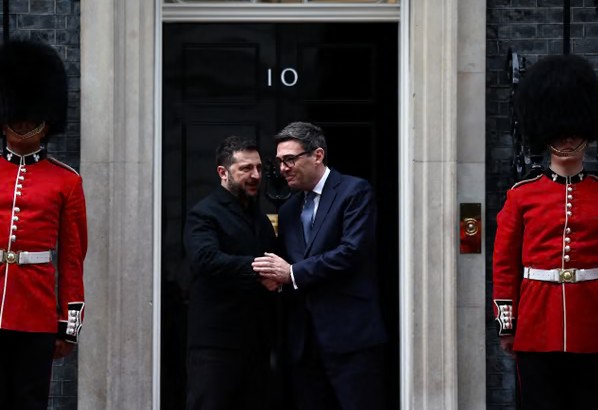
London was the natural place for Zelenskyy to turn. Andy Burnham received him at Downing Street with a ceremonial guard of the Irish Guards and pledged that British support would not change. He promised to speed up deliveries of lightweight multi-role missiles, which Ukraine uses against drones, said ministers were exploring every possible form of further help, and announced £17m toward repairing the protective structure over the Chornobyl nuclear plant, damaged in a Russian drone strike last year. Zelenskyy also met King Charles earlier that day.
Yet Britain cannot replace what the United States provides. There is no European satellite network ready to substitute for Starlink at scale, and no European intelligence service with American reach. Burnham’s choice to avoid public criticism of Trump reflects that reality: London’s most valuable role may be as the ally best placed to persuade Washington to restore what it has withdrawn, rather than as a substitute for it.
What Comes Next
Zelenskyy’s use of the word “betrayed” is a major shift. Since the Oval Office clash of 2025 he has worked to avoid an open break with Trump, knowing how much Ukraine depends on American systems. That he now speaks so directly suggests he believes quiet diplomacy has stopped working, or that the costs on the battlefield have become too high to stay silent.
The coming weeks will show whether the Starlink restriction is a temporary pressure tactic or the start of a broader American withdrawal. For Ukraine, the immediate question is military: how to defend its cities against jet-powered drones with a key tool degraded. For Europe, the question is strategic and long overdue: how much of its own security it is willing to leave in the hands of a single government that has shown it can switch off support in the middle of the night.