 11
11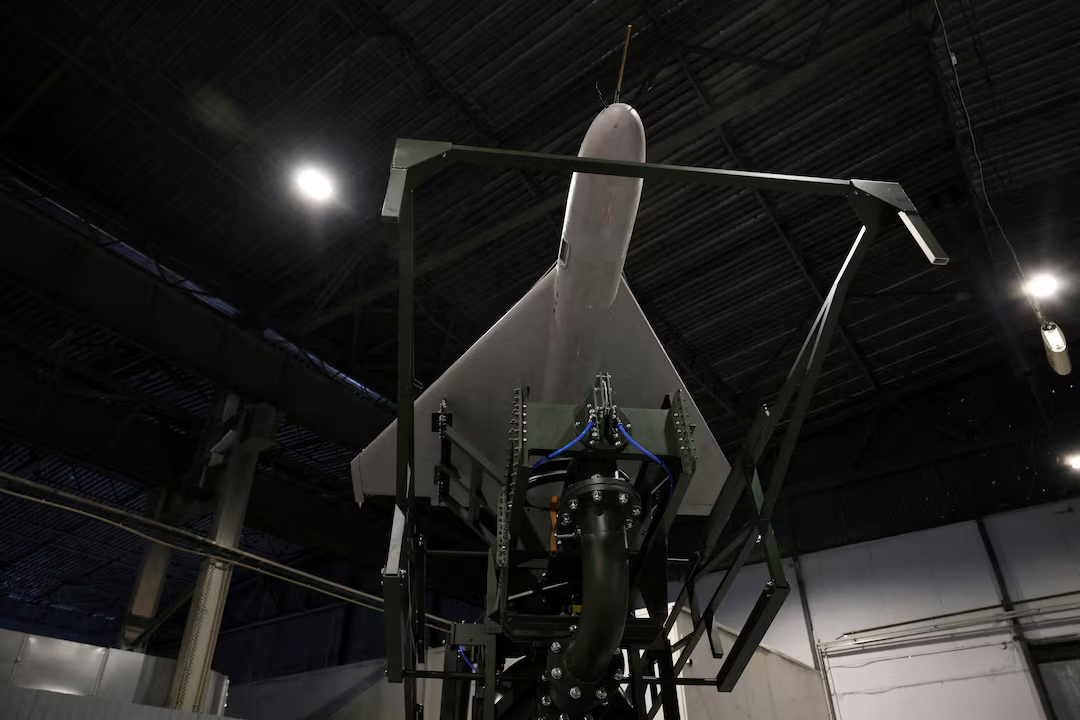
Poland is undergoing a major transformation of its defence strategy, combining the rapid expansion of its armed forces with a growing effort to build domestic and regional capacity to produce the weapons and equipment required to sustain a large military.
The shift reflects a fundamental lesson emerging from the Russia-Ukraine war: military strength depends not only on the size and sophistication of armed forces, but also on the ability to produce ammunition, repair equipment and replenish stocks quickly during a prolonged conflict.
According to Reuters, Poland’s spending on defence equipment from domestic companies and partnerships with Central European firms nearly quadrupled between 2022 and 2025, reaching 30.4 billion zlotys, or about $8.15 billion, last year. The country is projected to spend around €53 billion on defence in 2026, equivalent to approximately 4.7% of GDP.
Poland’s earlier military modernization strategy relied heavily on large-scale purchases from foreign suppliers, particularly the United States and South Korea. Those acquisitions helped Warsaw rapidly strengthen its military capabilities after Russia’s full-scale invasion of Ukraine.
However, dependence on distant suppliers presents strategic risks. In a major conflict, international manufacturers may face production bottlenecks, competing orders or logistical constraints. Poland is therefore increasingly seeking to manufacture more equipment domestically and within Central Europe.
This represents a shift from simply buying weapons to developing a sustainable defence-industrial ecosystem.
Poland is expanding cooperation with companies in countries including the Czech Republic, Estonia, Slovakia and Hungary, while also seeking greater investment from major European defence manufacturers. Reuters reported that Czech defence company CSG has become an important partner as Poland seeks to expand production of ammunition, drones and missiles.
The war in Ukraine has demonstrated the enormous quantities of ammunition and equipment required in modern high-intensity warfare. Precision weapons and advanced platforms remain important, but sustained combat also demands continuous supplies of artillery shells, drones, missiles, spare parts and other basic military equipment.
For Poland, which borders Ukraine and lies on NATO’s eastern flank, these lessons carry particular weight.
Warsaw increasingly views Russia as a long-term security threat and is building its armed forces accordingly. Poland has already surpassed 220,000 military personnel and is pursuing further expansion. Its objective is not merely to create one of Europe’s largest militaries in numerical terms, but to support that force with a reliable industrial base.
Poland’s industrial strategy could have consequences well beyond its own borders.
If Warsaw succeeds in expanding domestic production, the country could emerge as one of Europe’s principal defence manufacturing centres. Its geographical position gives it additional strategic importance: Poland can serve as a production and logistical bridge connecting Western European defence industries with the security needs of Central and Eastern Europe.
The emerging partnerships also point toward greater regional integration. Instead of each Central European country attempting to maintain entirely independent defence industries, joint production could allow governments to combine investment, technology and manufacturing capacity.
Such cooperation could strengthen Europe’s ability to replenish military stocks without relying exclusively on suppliers outside the continent.
Poland’s ambition, however, comes with substantial financial challenges.
Defence spending at nearly 5% of GDP places a significant burden on public finances, particularly as the government simultaneously has to fund infrastructure, social programmes and economic development. Poland’s growing defence budget therefore raises questions about how long such spending levels can be sustained.
There is also a difference between purchasing proven foreign systems and developing competitive domestic manufacturing capabilities. Building factories, acquiring technology, training skilled workers and establishing reliable supply chains require years of investment.
Consequently, Poland’s strategy is unlikely to eliminate foreign dependence in the short term. Instead, Warsaw appears to be pursuing a hybrid model: purchasing advanced systems from trusted allies while progressively increasing domestic production and technological capabilities.
Poland’s military expansion is closely aligned with the broader transformation of European security policy since Russia’s invasion of Ukraine. Warsaw is targeting defence spending of 5% of GDP by 2035, reinforcing its position as one of NATO’s most committed members in terms of military investment.
Its approach could also influence other European countries confronting the same challenge: how to rebuild defence industries after decades of relatively low military spending.
If Poland can successfully combine a large standing army with a robust domestic defence industry, it could provide a model for other European states seeking greater strategic autonomy.
The significance of Poland’s defence transformation extends beyond the number of soldiers or weapons it possesses. The country is attempting to create an integrated military-industrial system capable of supporting sustained operations, reducing supply vulnerabilities and strengthening cooperation with neighbouring allies.
The central strategic calculation is clear: a powerful army cannot remain dependent on fragile or distant supply chains if it is expected to respond to a prolonged security crisis.
Poland’s pivot toward home-grown and regional defence production therefore represents not simply an industrial policy, but a broader effort to redefine the country’s role in Europe’s security architecture.
If successful, Warsaw could emerge not only as the home of Europe’s largest land army, but also as one of the continent’s most important defence-industrial powers.