 11

Few prime ministers enjoy a run of good fortune like the one Andy Burnham is currently having. Labour’s victory in the Holborn and St Pancras byelection, where candidate Sagal Abdi-Wali defeated Green Party leader Zack Polanski in the early hours of Friday, is the latest in a series of political gains for a leader who appears unusually well served by the weaknesses of his rivals.
The scale of the result is easy to underestimate. Veteran psephologist Peter Kellner noted that the win “defied history.” Over the past half-century, Labour has had a poor record defending its own seats in government when challenged from the left or centre-left. In such contests, the average swing against the party has been around 24 percent. On that basis, Polanski should have won comfortably. That he did not is a significant moment for Burnham.
The result also supports the central argument Burnham made when he sought to replace Keir Starmer, the seat’s previous MP, as Labour leader: that he was uniquely placed to fend off challenges from both left and right. Together with his own byelection success in Makerfield in June, the London win offers early evidence for that claim. Burnham’s leftward shift appears to have convinced many progressive voters that they no longer need to back the Greens to see their priorities reflected, and that Labour deserves another chance.
Burnham has also benefited from the Greens’ own difficulties. Polanski initially brought new energy and a surge in membership to the party, but critics argue it has since lost much of the moral standing it once enjoyed as Britain’s leading environmental voice. Controversy erupted after the party’s conference passed a motion describing Zionism as racism and calling for a Palestinian state to replace Israel rather than exist alongside it. Critics point out that the motion called for this to be achieved “by all available means,” which an accompanying booklet from its proposers said included armed struggle. Polanski did not take part in the vote, and has since said he would not have supported the resolution. That response has drawn sharp criticism of his leadership, and former leader Caroline Lucas notably declined to say whether he should remain in post. For Labour, a weakened Green leadership is a clear advantage.
On the right, Reform UK’s conference was overshadowed by reports that two senior aides to Nigel Farage were filmed apparently discussing how to get around UK electoral law to accept a £500,000 donation from a US backer. The episode is particularly damaging because it reinforces existing public perceptions: a YouGov poll in July found that three in four Britons viewed Farage as sleazy, with 56 percent describing him as “very sleazy.” The party’s policy announcements were further overshadowed by Suella Braverman’s controversial remarks suggesting that some ethnic minorities born and raised in England are not truly English, a definition that critics noted would exclude former Prime Minister Rishi Sunak and members of the England football team.
Reform’s troubles have given the Conservatives an opportunity to reclaim their position as the main party of the right, but Kemi Badenoch’s conference offer may have handed Burnham an even greater advantage. Although her personal ratings remain higher than her party’s, and she appears to recognise that the Conservatives must win back the Middle England seats lost to the Liberal Democrats in 2024, her key pledges were to abolish inheritance tax even on the most expensive homes and to extend free childcare to those earning over £100,000. These create a dividing line Labour will welcome. At a time of tight public finances, Burnham will be eager to argue that the Conservatives’ priority is helping the wealthiest.
The Liberal Democrats, meanwhile, remain a relatively unthreatening home for Conservative-sceptic voters in areas where Labour is unlikely to compete. Burnham is nonetheless trying to win over some of their supporters by promising action in the next parliament on two of their signature issues: Europe and electoral reform.
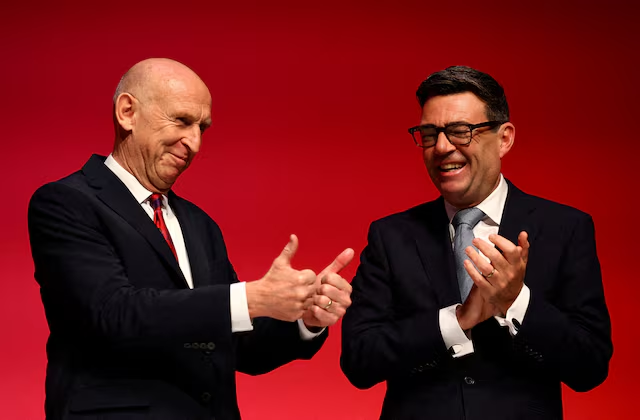
Burnham’s own conference speech was widely seen as the highlight of the season. It presented a leader comfortable making and defending political arguments. One cabinet minister reportedly said that, after Starmer, listening to Burnham felt like gulping down oxygen.
Yet the challenges ahead are serious. Government borrowing costs remain high, and cuts to the welfare budget are widely expected. Labour MPs who are applauding now may be less enthusiastic when asked to vote for reduced benefits, particularly as reselection contests in local parties begin in January. The government must also fill a gap in defence spending, meet growing demands from public services, cope with the inflationary risk of rising global oil prices linked to US policy, and deal with a civil service that ministers privately regard as bloated and ineffective. Valuable time in the middle of the parliament, when governments should be focused on delivery, has also been spent on the leadership transition.
For now, Burnham is benefiting from opponents whose choices are hurting them and helping him. But political fortunes rarely last, and when harder decisions arrive, the prime minister’s good luck will face its real test.