 11
11
President Vladimir Putin’s warning to Armenia over its growing engagement with the European Union reflects a broader geopolitical reality: Russia is increasingly relying on economic pressure and security leverage to retain influence over traditional allies while facing sustained Western diplomatic and strategic expansion.
At the center of the latest tensions is Armenia, a historically close partner of Russia, which has begun steadily diversifying its foreign policy. Armenia’s recent steps—including closer engagement with the European Union, expanded cooperation with the United States, and legal preparations for potential EU membership—have triggered a sharp response from Moscow, which sees these moves as a direct erosion of its regional sphere of influence.
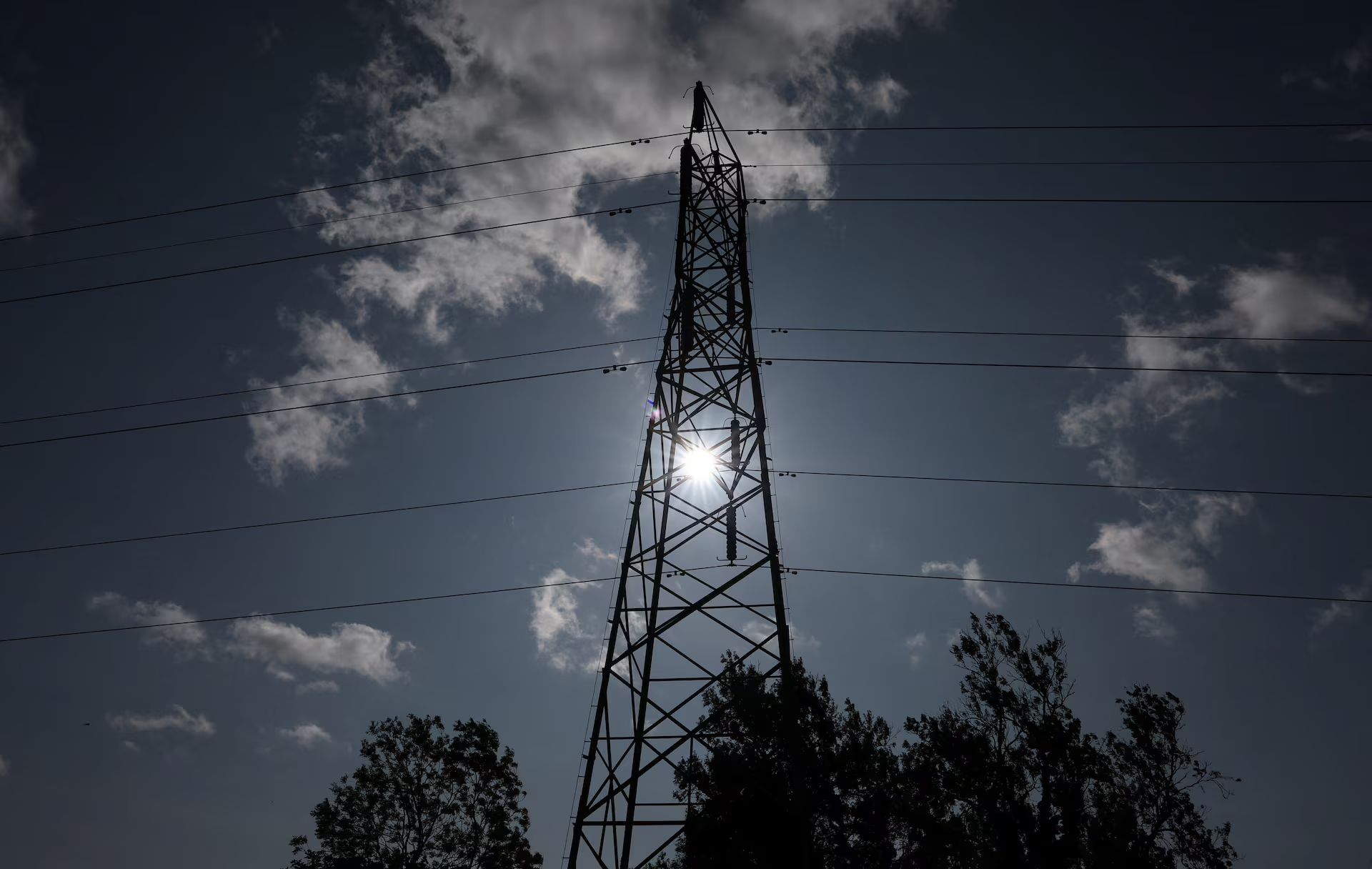
Putin’s reported warning—that Armenia could lose access to discounted Russian oil and gas if it continues its pro-EU trajectory—underscores how energy dependency remains a key instrument of Russian foreign policy. Armenia’s landlocked geography and limited energy alternatives make it particularly vulnerable to such pressure, reinforcing Moscow’s ability to influence political decision-making through economic means.
This approach is not new. Russia has previously imposed temporary trade restrictions on Armenian exports and has hinted at broader consequences, including possible exclusion from Russian-led economic structures such as the Eurasian Economic Union.
The confrontation comes against the backdrop of Russia’s prolonged war in Ukraine, now stretching beyond four years. The conflict has significantly strained Moscow’s diplomatic bandwidth, limiting its ability to maintain influence across multiple regions simultaneously.
While Russia remains militarily engaged in Ukraine, Western powers—particularly the EU and US—have intensified efforts to strengthen ties with countries historically aligned with Moscow. This includes regions as diverse as the South Caucasus, Central Asia, and parts of Latin America and Africa.
Beyond Armenia, several other states have recently shown signs of recalibrating their foreign policy positions:
Meanwhile, Moscow’s traditional allies in regions such as Cuba, Venezuela, and Iran are also under pressure or experiencing shifting dynamics due to external sanctions, energy market volatility, and changing geopolitical priorities.
Russian officials and analysts increasingly acknowledge that Moscow is operating in a more competitive global environment. Statements from the Russian Foreign Ministry highlight concerns over what it describes as Western efforts to “detach” Armenia from Russia’s orbit.
At the same time, internal commentary within Russian policy circles suggests a growing recognition that the war in Ukraine has accelerated geopolitical realignments. Countries once firmly aligned with Moscow are now “waiting to see” the outcome of the conflict before committing to long-term strategic choices.
Putin’s warning to Armenia is not an isolated diplomatic episode but part of a broader pattern of intensified geopolitical competition. As Russia focuses on sustaining its war effort in Ukraine, Western powers are expanding their engagement with regions once considered firmly within Moscow’s sphere of influence.
The result is an increasingly fragmented geopolitical landscape, where economic dependence, energy security, and institutional alignment are becoming decisive tools in a global contest for influence.