 11
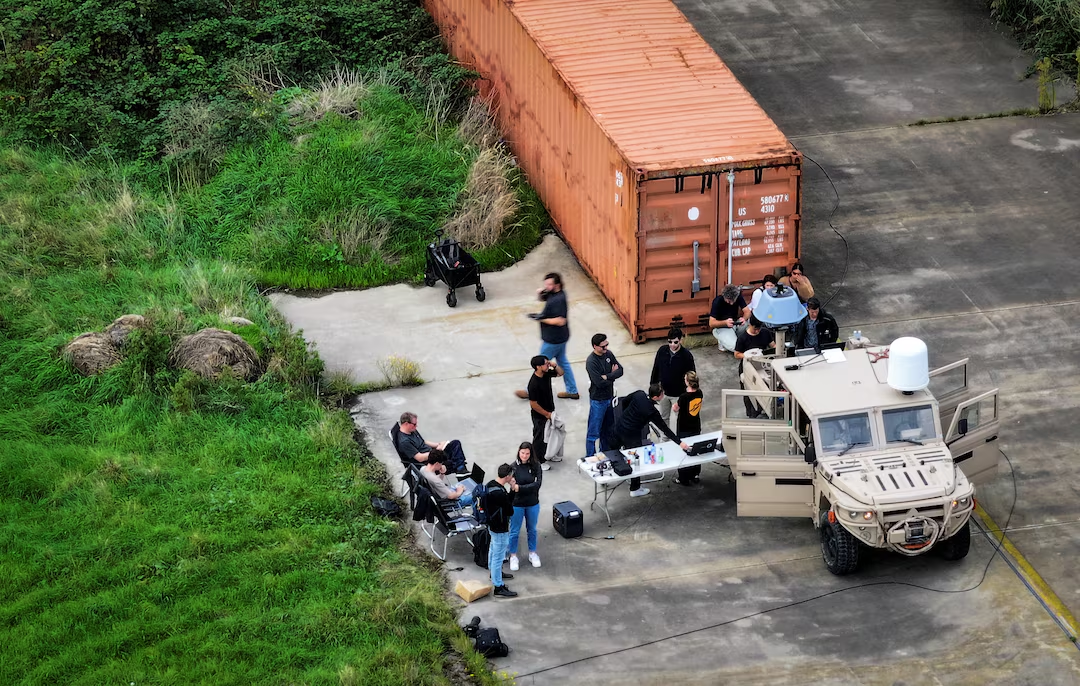
Katwijk aan Zee: A Dutch software company is using artificial intelligence to link together the many different drone and air-defence systems supplied to Ukraine, in an effort to speed up the country’s response to intensifying Russian drone and missile attacks.
Amsterdam-based Intelic, one of scores of defence technology firms operating out of converted hangars at a disused airbase on the North Sea coast, recently demonstrated its AI-powered software, Nexus, in a live test. In the late-September trial, a high-velocity interceptor drone was launched from the airbase and destroyed a mock enemy target that had been detected by radar and verified using artificial intelligence.
During the test, Nexus drew on multiple radars, sensors and cameras supplied by other companies to identify the incoming projectile as hostile. A reconnaissance drone then confirmed through image recognition that the object was an enemy drone. Although a human operator made the final decision to launch the AI-guided interceptor, Intelic’s chief executive and founder, Maurits Korthals Altes, said the process could be carried out fully autonomously.
Korthals Altes explained that AI is used both on board the drones themselves, enabling them to strike fast-moving aerial targets at high speed, and as a decision-support tool for commanders, who sometimes have only seconds to decide whether to engage an incoming jet-powered drone.
The company, which holds a €30 million contract with the Dutch Defence Ministry to upgrade the country’s air defences, now has an office in Kyiv. Its command-and-control system is being rolled out on Ukraine’s battlefield, where operational decisions are sometimes still relayed through chat applications or phone calls, and it supplements Delta, Ukraine’s own advanced battlefield management system.
Kyiv has increasingly turned to its allies to strengthen its air defences, but the wide variety of drones produced by European manufacturers do not always work with one another. Anika Kempter, a senior software engineer at Intelic, noted that Europe now has more than 700 drone manufacturers and said a connecting system linking them is essential if the continent is to remain technologically sovereign. She added that replacing human communication with automated systems can shave minutes off the time between detecting a drone and attempting to shoot it down, which can make the difference between life and death.
Korthals Altes said that drone technology evolves so rapidly that air-defence hardware can quickly become outdated, but software such as Nexus can bridge the gap by integrating new weapon systems into a single platform.
Since 2022, the Netherlands has provided Ukraine with military aid worth more than €12.5 billion, including nearly one million drones, according to the Dutch Defence Ministry.