 11

Half a century after Jim Sillars coined “independence in Europe,” Brexit has turned the SNP’s founding promise into its hardest problem, and a Labour prime minister may be the one to solve it
In October 1976, a small band of left-wing Scots met in a Stirling hotel to launch what they hoped would reshape the politics of their country. The Scottish Labour Party, a breakaway led by the charismatic South Ayrshire MP Jim Sillars, had walked out of Labour earlier that year in frustration at the party’s half-hearted plans for a Scottish assembly. Its promise was bold: to reunite the two traditions then competing for Scotland’s future, socialism and home rule, under a single banner.
For a brief moment the experiment captured the national imagination. Prominent thinkers such as Tom Nairn, Hamish Henderson and Neal Ascherson rallied to the cause, and the press treated the new party as a phenomenon. Yet the working-class voters Sillars needed never came in large numbers. What did arrive was a contingent of Trotskyist activists, and the inaugural conference descended into a bitter and near-physical purge of the far left, with one organiser invoking Ayrshire’s mining past to urge members to fight the infiltrators. The party never recovered from that spectacle and soon faded from view.
Its legacy, however, proved far more durable than its organisation.
An idea that outlived its party
To make national self-determination acceptable to socialists wary of narrow nationalism, the Scottish Labour Party embraced the European Economic Community. Its formula, “independence in Europe,” recast separation as partnership: if goods, people and services crossed borders freely, then leaving the United Kingdom would mean equality among interdependent nations rather than isolation.
When the party collapsed, Sillars carried the slogan into the Scottish National Party, eventually becoming its deputy leader in 1991. The shift was remarkable. In the 1970s the SNP had built early momentum as a Eurosceptic force, opposing EEC membership in the 1975 referendum and setting itself apart from the pro-European Westminster parties. By the 1990s it had turned completely around, encouraged by a European Union that increasingly championed small nations and minority cultures.
That Europeanism became part of Scotland’s political identity, sharpened by the country’s habit of defining itself against an England that was drifting in the opposite direction. It also shaped the 2014 independence referendum, in which Scots were warned that a new state would have to apply afresh for EU membership. Many voted No partly to keep their European citizenship. Two years later, they voted decisively to remain in the EU, only to be outvoted by England’s far larger electorate.
Scotland had, in effect, been asked to choose between its two unions in the wrong order. Support for independence rose briefly after the Brexit vote, then fell back as voters balked at another rupture. It was only the combination of Boris Johnson’s premiership, a hard Brexit settlement and the strains of the pandemic that pushed Yes into a sustained lead.
The border problem
Today the two sides are roughly level, but the economics of independence have been transformed. The core political argument remains intact, and has arguably been strengthened: British politics is heavily centred on England, and Brexit is the clearest example of Scotland’s preferences being overridden. The practical argument, however, has become far harder. An independent Scotland that rejoined the EU would face a customs and regulatory frontier with the rest of the UK, a market that takes more Scottish exports than the entire rest of the world combined.
Some nationalists point to Northern Ireland, which now straddles both the UK and EU markets, as a possible model. The comparison is weak. Northern Ireland’s arrangements exist because of the fragility of the peace there and the history of violent conflict over partition. Scotland poses no comparable risk, and there is little reason to expect Brussels, London or the wider international community to grant it equivalent special status.
This exposes a paradox at the heart of modern Scottish nationalism. Its greatest strength is that it is civic rather than ethnic, rooted not in ancient grievance but in a reasonable, democratic disappointment with Westminster’s retreat from secure employment, decent public services, international cooperation and a shared sense of national purpose. But a movement built on that kind of moderate discontent is poorly suited to persuading voters to accept a costly and disruptive break.
Burnham’s double-edged challenge
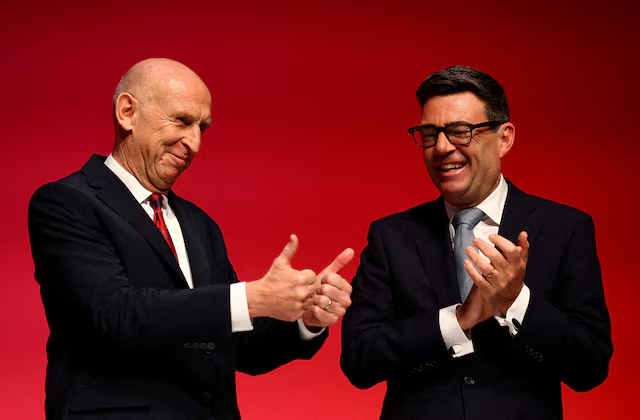
This is where Andy Burnham enters the story. In October, as the SNP gathered in Aberdeen for a conference far calmer than Stirling’s in 1976, the prime minister spoke in Motherwell, offering to work with Holyrood on deeper devolution. On 30 October he convened the National Economic Council in Glasgow with First Minister John Swinney and Welsh First Minister Rhun ap Iorwerth, a meeting framed around combining devolved power with reindustrialisation. Fifty years on, that is almost exactly the programme the Scottish Labour Party once demanded.
Burnham is a genuine threat to the SNP because he is selling precisely what the independence movement says Britain has lost: dignified work, revived industry, a functioning welfare state and empowered regions. He also communicates with a fluency that Scottish Labour has long lacked and the SNP has long monopolised.
Yet his project may serve the nationalist cause in an unexpected way. It is doubtful that any prime minister, in three years or ten, can fully restore the industrial Britain his speeches evoke. What looks increasingly likely is that delivering even part of his agenda will require repairing Britain’s economic relationship with Europe. Closer alignment with the EU, whether on trade, standards or market access, would soften the very border that now makes independence so daunting.
The verdict
The irony is striking. The idea Jim Sillars imported into the SNP was designed to make leaving Britain feel less like a rupture. Brexit turned that idea on its head, making Scotland’s European future and its British present seem mutually exclusive. If Burnham rebuilds the bridge to Brussels as a condition of his own success, he will have restored the single piece of infrastructure Scottish independence most depends on.
Should his wider promise of national renewal deliver, the case for leaving the UK weakens. Should it falter, Scotland may find the path to “independence in Europe” more open than at any time since 2016. Either way, the future of the union may be decided less in Edinburgh or London than in the state of Britain’s relations with the continent.