 11
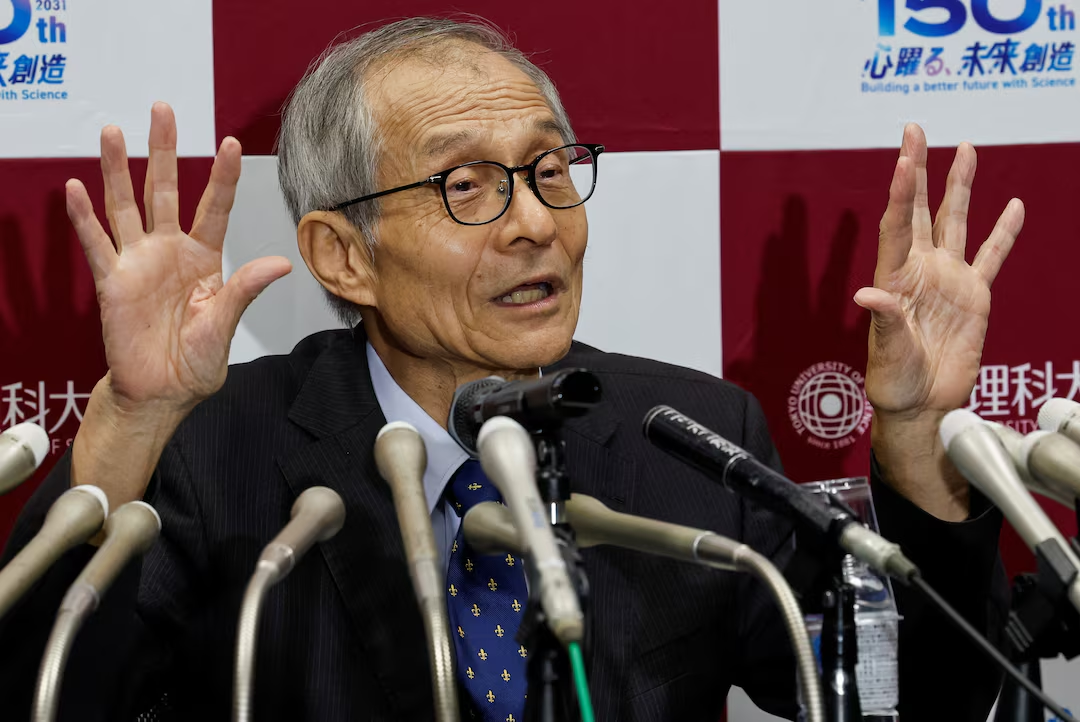
Stockholm: French chemist Henri B. Kagan and Japanese scientist Kenso Soai have been awarded the 2026 Nobel Prize in Chemistry for solving a long-standing scientific riddle surrounding asymmetric “mirror image” molecules, a breakthrough of major significance for pharmaceutical manufacturing, the Royal Swedish Academy of Sciences announced on Wednesday.
The laureates were honoured for their discovery of non-linear effects and autocatalysis in asymmetric organic synthesis. Many molecules exist in two forms that are mirror images of one another, much like a pair of left and right hands, a property known as chirality. While the two forms can behave very differently, particularly in medicines, living organisms overwhelmingly use only one of them. Their work builds on a discovery made in the 19th century by the French chemist Louis Pasteur.
“Henri Kagan and Kenso Soai have provided a solution to a chemical mystery that is over a century old: how homochirality can emerge spontaneously,” said Heiner Linke, Chair of the Nobel Committee for Chemistry, describing the reactions the two scientists developed as spectacular.
In the early 1980s, Professor Kagan, affiliated with Université Paris-Sud in Orsay, developed methods of controlling chemical reactions using different catalysts, enabling scientists to produce a greater excess of one mirror-image form over the other. Professor Soai, of the Tokyo University of Science, built on this work by designing a reaction, now known as the “Soai reaction”, in which only one of the two possible forms is produced. The Nobel Committee noted that, apart from life itself, no one had previously achieved such a feat.
The committee said the laureates’ research has given chemists fundamental tools now widely used in their daily work, while also reviving scientific interest in the chemistry of the origins of life. The ability to select which mirror image of a molecule to produce is crucial in the manufacture of safer and more precise medicines, as well as flavours and fragrances.
Speaking by telephone to the press conference from Hiroshima, Professor Soai, 76, said it was the most exciting day of his life and that he was very glad to share the honour with Professor Kagan, adding that he had been out shopping when he received the news. The committee said it had not yet been able to reach Professor Kagan, who at 95 becomes the third-oldest person ever to receive a Nobel Prize.
The laureates will share the prize of 12 million Swedish kronor, approximately USD 1.2 million. The chemistry award is the third Nobel Prize announced this week, following the prizes for medicine and physics on Monday and Tuesday.